We are happy to report that Parallax Information’s founder and principal consultant has joined the Conflict Analytics Lab at Queen’s Faculty of Law and Smith School of Business at Queen’s University. She will be advising on the Lab’s OpenJustice project.
Here is the official announcement:
The Conflict Analytics Lab at Queen’s University is is excited to announce the appointment of Sarah Sutherland to the Advisory team of OpenJustice, an open-access generative AI for legal information.
Ms. Sutherland brings a wealth of experience and expertise in legal technology and data integration to the OpenJustice team. As a thought leader in the legal sector, Ms. Sutherland has been instrumental in helping organizations leverage quantitative methods for enhanced planning and operations. Her insights into the intersection of legal processes and data have positioned her as a key figure in shaping the future of legal information management.
We are happy to announce that Jobina Bardai is joining Parallax Information as assistant and project manager. As we grow and expand our horizons, we recognize the importance of having a dedicated and talented team.
Jobina brings a strong background in administration, project management, and business. She has worked with a variety of businesses and specializes in developing systems that make organizations flow better. She also brings a commitment to creative expression, which she expresses outside of work as a contemporary dancer.
Please join us in extending an enthusiastic welcome to Jobina. We’re thrilled to have her join us as we grow. She brings unique skills and perspective, which will contribute to exceptional service to clients across the legal, technology, and information organization sectors.
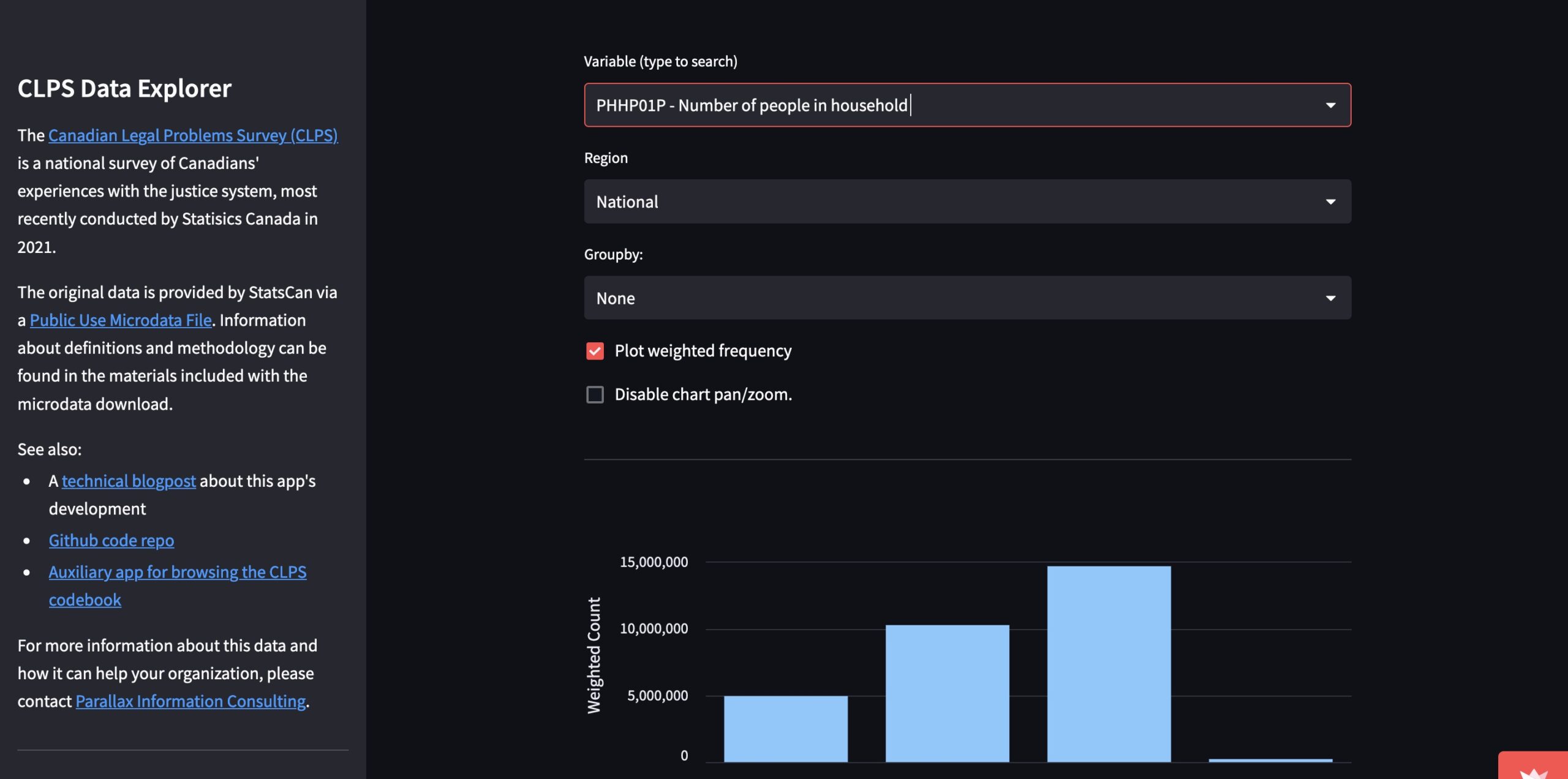
I am happy to share a newly created dashboard to facilitate navigation of the results from the Canadian Legal Problems Survey. You can access the dashboard here. It is designed to allow you to explore the data to better understand what legal problems Canadians experience, how they respond, and how demographic variables correspond to legal problems. The data is pulled from the Canadian Legal Problems Survey Public Use Microdata File (PUMF), which is available from the Statistics Canada website.
The dashboard was coded by Andrew Wong, a data scientist in Vancouver, BC. Andrew started his career as a cell biologist and is now focused on data science to further his passion for understanding complex systems. You can find his portfolio at mixedconclusions.com.
We hope you find the dashboard interesting. If you’d like to discuss how a more detailed analysis of this or other data could support your organization, please contact us.
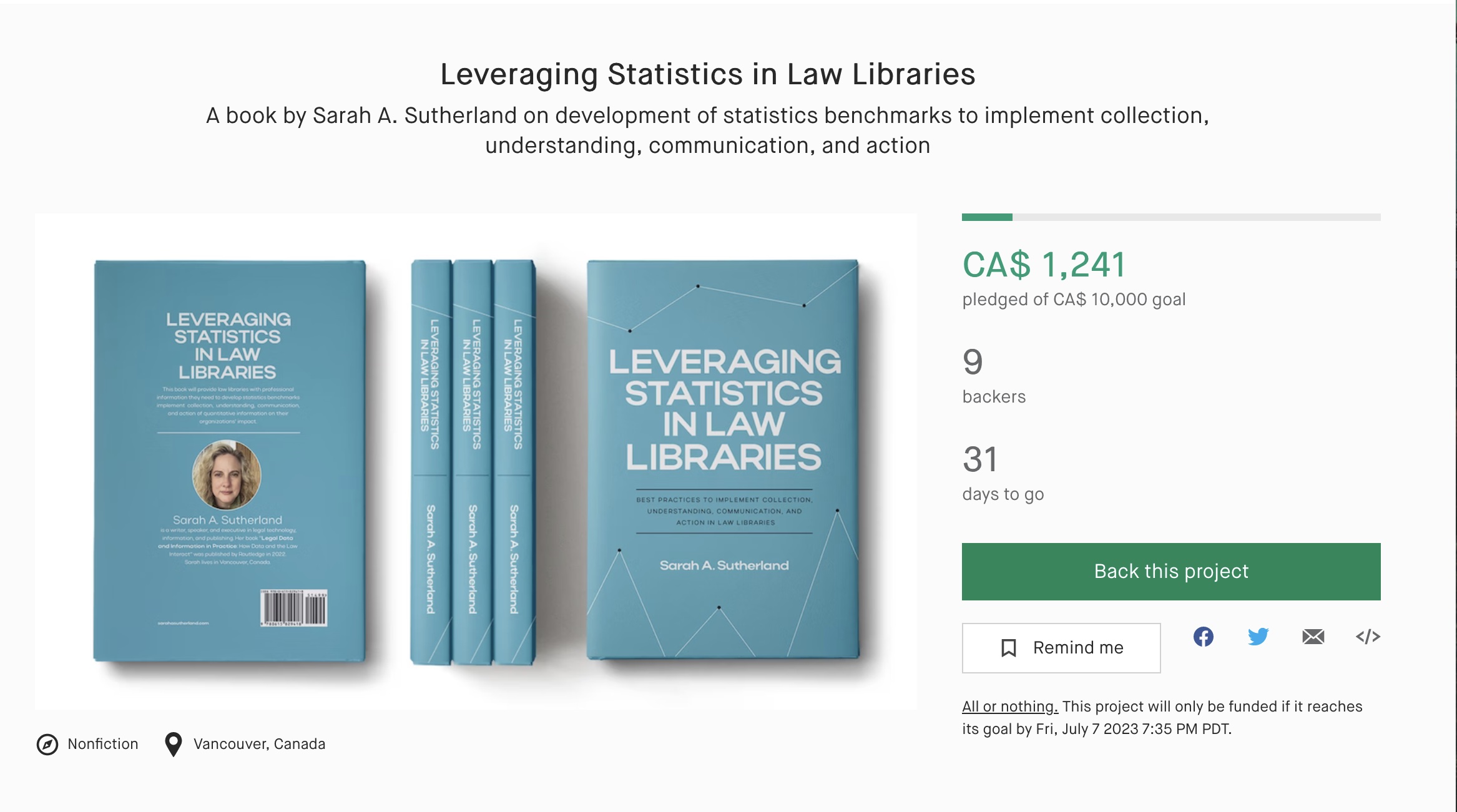
Running a Kickstarter campaign is a new way to fund the development of legal texts, and I know it can be inconvenient to figure out how to administer things like this, but it’s worth it! This model of developing legal materials will allow the community to help ensure that the tools we need are available. Libraries regularly purchase books before they are published, and this is just another way to handle that.
Here is some background on why I am doing this project on Slaw.ca. There is also more information about the project on the Kickstarter campaign page, and if you’re still not sure about it, please check back. I will be posting a table of contents in the coming days.
I’m so glad that we can work together to make a great legal information system in Canada. I’m looking forward to seeing what the next stage looks like.
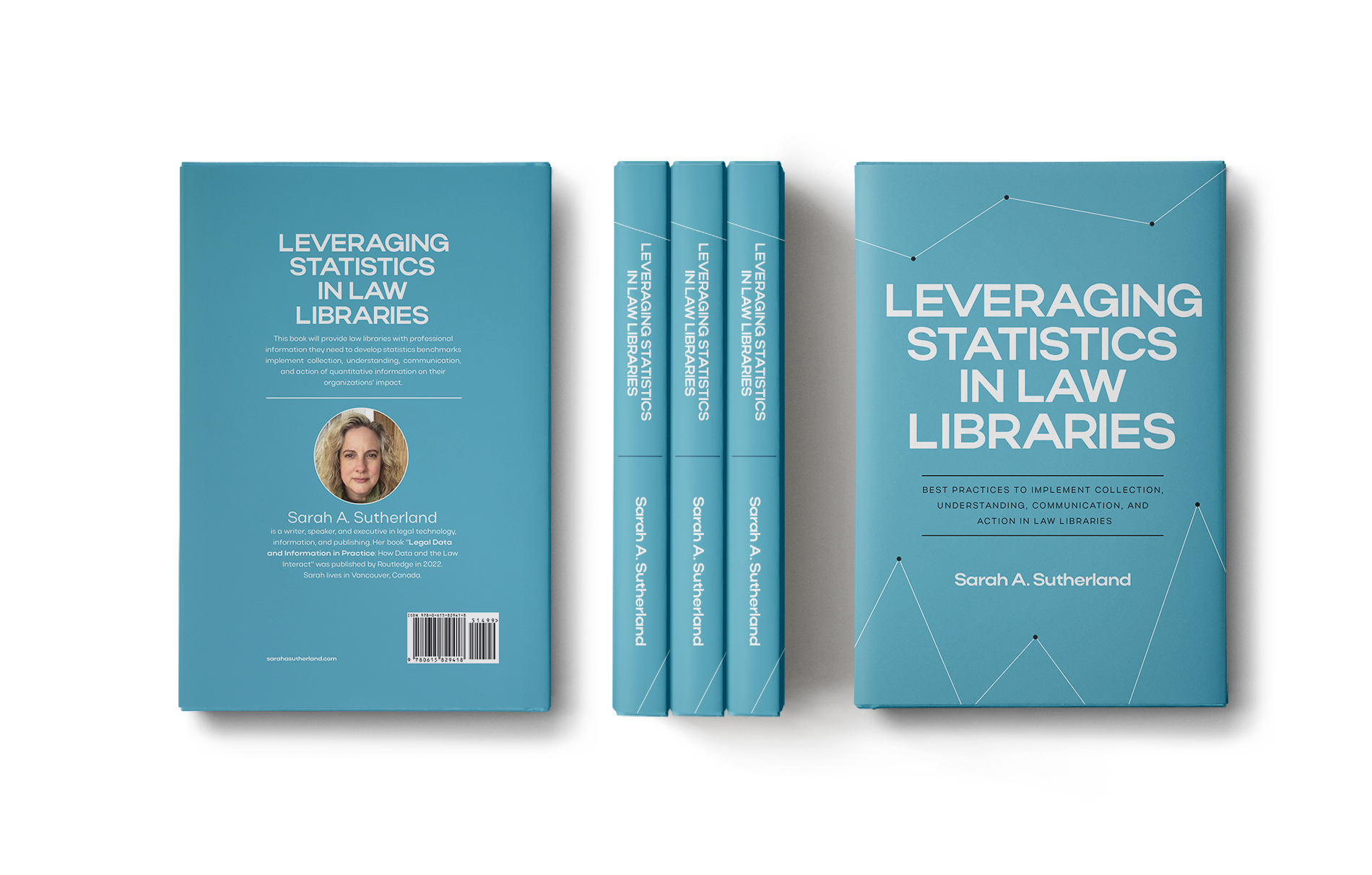
Libraries are increasingly required to use evidence in their management and reporting to ensure that the services they provide are appropriate and that they are communicating their impact to stakeholders. Library staff also need better insights into how resources are used and what stakeholders need to make decisions that reflect user needs. Better statistics have the potential to drive important improvements in how we manage law libraries, but it is hampered by the fact that much of the value libraries provide is not easily assessed.
This is a perfect example of a topic that is poorly handled in the current publishing landscape: it has a small audience, is technically challenging, and is both too small to be suitable for a book topic and too large to be viable as an article. It is also not sufficiently valuable in any individual organization to be something that consultants would be likely to be hired to create, partly because having shared standards that are widely understood and used is more valuable than an individual institution creating something internal.
In this project I propose to do research integrating a deep knowledge of data and its application in the management of information organizations, and a literature review, as well as a series of interviews with people working in law libraries around the world. This will be integrated into a book which will be made available in ebook and professionally produced print formats.
My main goal is to develop systems for the particular needs that libraries have for their data. It will also include guidance on how to approach the questions of what to collect and how to interpret it based on organizational goals. Not every organization has the same priorities and data programs should reflect that.
I hope you will be willing to pitch in to help create this resource, or perhaps you will think of your own gap to fill.
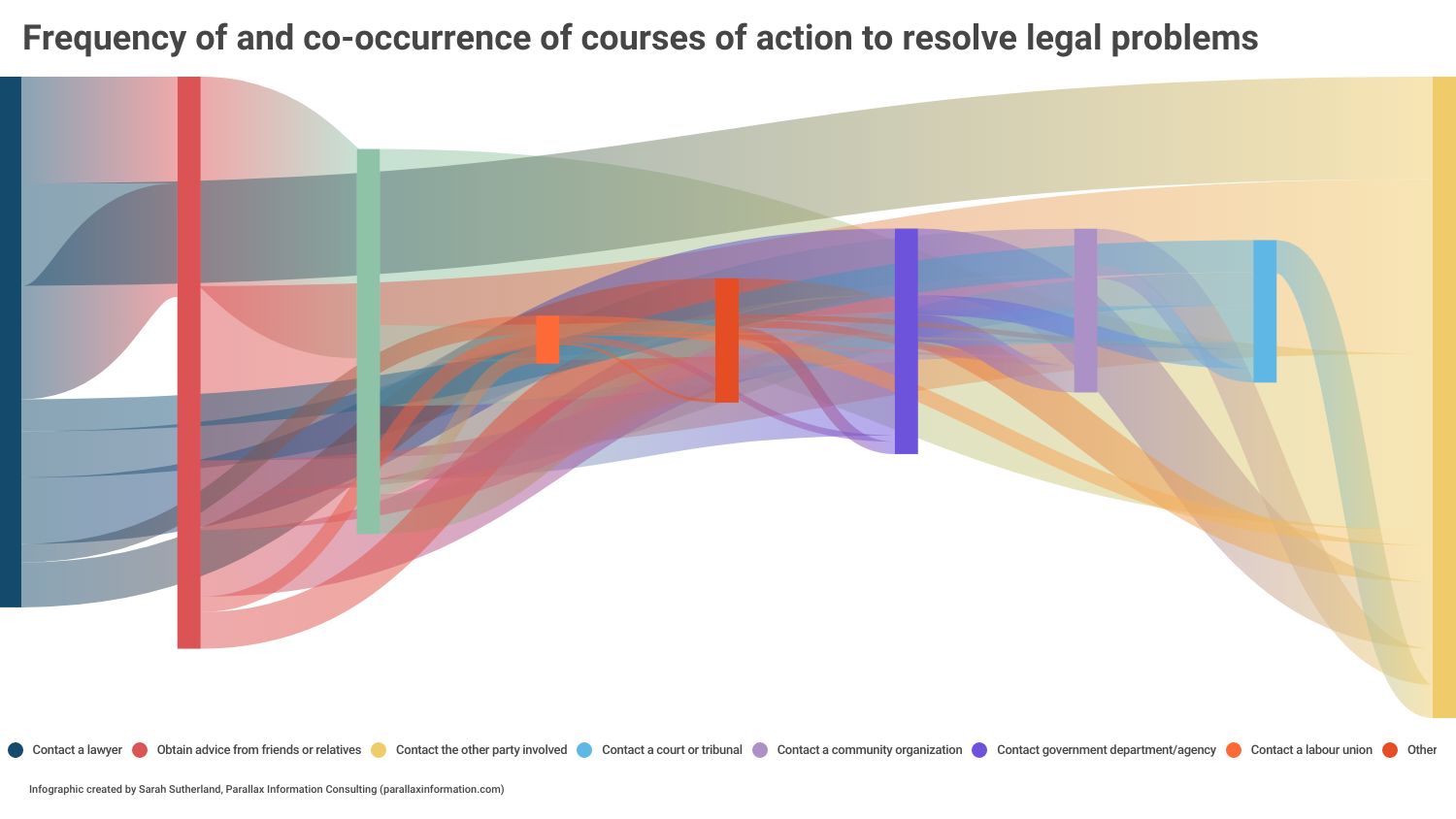
One of the interesting things that came out of my research into the results of the Canadian Legal Problems Survey is how people pursue different courses of action to resolve their legal problems and how the different courses of action interact.
Here is a graph of the frequency of course of action and and how actions co-occur. The actions are ordered from left to right in order of how helpful people found the action to be.
On April 4, 2023, I published an article in the Canadian Bar Association’s National magazine titled “Are 80% of legal problems in Canada really going unmet?” It explores the question of whether people’s needs are being me in Canada’s legal system based on the data in the Canadian Legal Problems Survey.
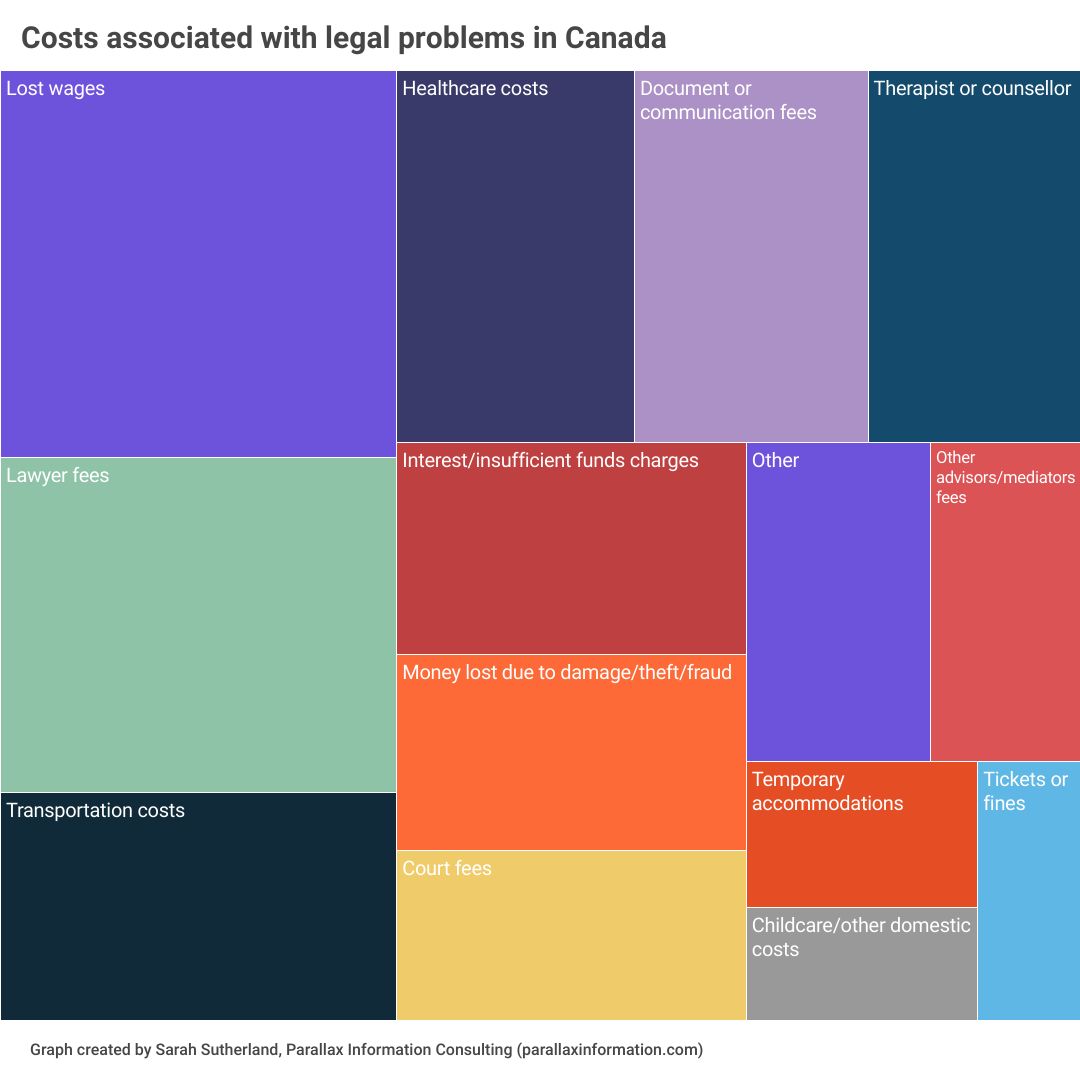
One topic I wanted more insight on was what the sources of costs for people with legal problems that caused financial hardship are. Here is a visualization of the proportion of people reporting costs associated with each category for the 2.6 million Canadians who have financial difficulties associated with their legal problems in a year: