×

Updates from our founder, Sarah Sutherland

Exploring Legal Innovation with Sarah Sutherland
Sarah continues to make significant contributions to the intersection of law and
technology. Her recent engagements and features highlight the evolving role of artificial
intelligence and data science in legal practice, as well as the impact of emerging
technologies on legal research and writing.

Judging the Canadian LLM x Law Hackathon
Sarah was honored to serve as a judge at the inaugural Canadian LLM x Law
Hackathon, co-hosted by CodeX, The Stanford Center for Legal Informatics, and
Queen’s Conflict Analytics Lab. This event brought together AI innovators and legal
professionals to explore how technology can shape the future of legal practice. It was
an inspiring experience to witness so much creativity and ingenuity directed toward
making the law more accessible and efficient through technology.

Featured in Colleges of Law Blog Post
Sarah was recently profiled in a Colleges of Law blog post by Ian Morris. The article
emphasized the transformative role of artificial intelligence in the legal field:
*AI is revolutionizing legal work by handling complex, large-scale tasks that would
otherwise be challenging for humans to perform efficiently.
*The integration of AI can reduce legal costs for both practitioners and their
clients, making legal services more affordable.
*Despite technological advancements, the legal profession will always require
educated professionals who can adapt to an ever-evolving landscape.

Thompson Rivers Law School Lecture
Sarah also recently delivered a lecture at Thompson Rivers Law School, where she
discussed the application of data science in legal research. Her talk shed light on the
numerous opportunities for legal scholars to harness data science tools, as well as the
potential for data scientists to discover compelling new datasets for research. The
session provided valuable insights into how interdisciplinary collaboration can drive
legal innovation forward.

Addressing the Impact of Text Generation in Legal Practice
The American Association of Law Libraries recently featured Sarah’s thought-provoking
Slaw column, “Cheapening the Written Word”. In this piece, she examines the
unexpected effects of text generation tools on legal practice and the integrity of legal
writing. The article raises important questions about the future of legal documentation
and the ethical considerations surrounding AI-generated content.

Pioneering the Future of Law and Technology
Sarah’s work at the intersection of law and technology continues to shape the legal
industry’s future. Through her involvement in hackathons, scholarly discussions, and
thought leadership, she is helping to bridge the gap between legal professionals and
technological advancements. As AI and data science become more integrated into legal
practice, Sarah’s insights and contributions remain invaluable in guiding the profession
forward.


 

JURISIN: Observations from the first day

Parallax Information’s Sarah Sutherland has shared some key takeways she had following the first day of the JURISIN Conference in Hamamatsu, Japan:

1. The research hasn’t been done to yet to explore what the law should be to reflect the emerging environment where AI applications are in wide use. – Mihoko Sumida, Hitotsubashi University, Japan

2. Rule-based AI systems need to be further developed to ensure that they present their outputs in ways that laypeople can understand. – Marco Billi, University of Bologna

3. Legal frameworks are increasing the requirement for transparency and explainability in AI systems, which may challenge the viability of black box systems over the long term. – Francesca Toni, Imperial College, UK

Read more about the Workshop here.

Sarah Sutherland joins Conflict Analytics Lab

We are happy to report that Parallax Information’s founder and principal consultant has joined the Conflict Analytics Lab at Queen’s Faculty of Law and Smith School of Business at Queen’s University. She will be advising on the Lab’s OpenJustice project.

Here is the official announcement:

The Conflict Analytics Lab at Queen’s University is is excited to announce the appointment of Sarah Sutherland to the Advisory team of OpenJustice, an open-access generative AI for legal information.

Sarah Sutherland is the Founder and Principal Consultant at Parallax Information Consulting Ltd. Furthermore, she is the author of Legal Data and Information in Practice: How Data and the Law Interact”, published by Routledge in 2022.

Ms. Sutherland brings a wealth of experience and expertise in legal technology and data integration to the OpenJustice team. As a thought leader in the legal sector, Ms. Sutherland has been instrumental in helping organizations leverage quantitative methods for enhanced planning and operations. Her insights into the intersection of legal processes and data have positioned her as a key figure in shaping the future of legal information management.

You can read the full announcement here.

More information on Kickstarter campaigns

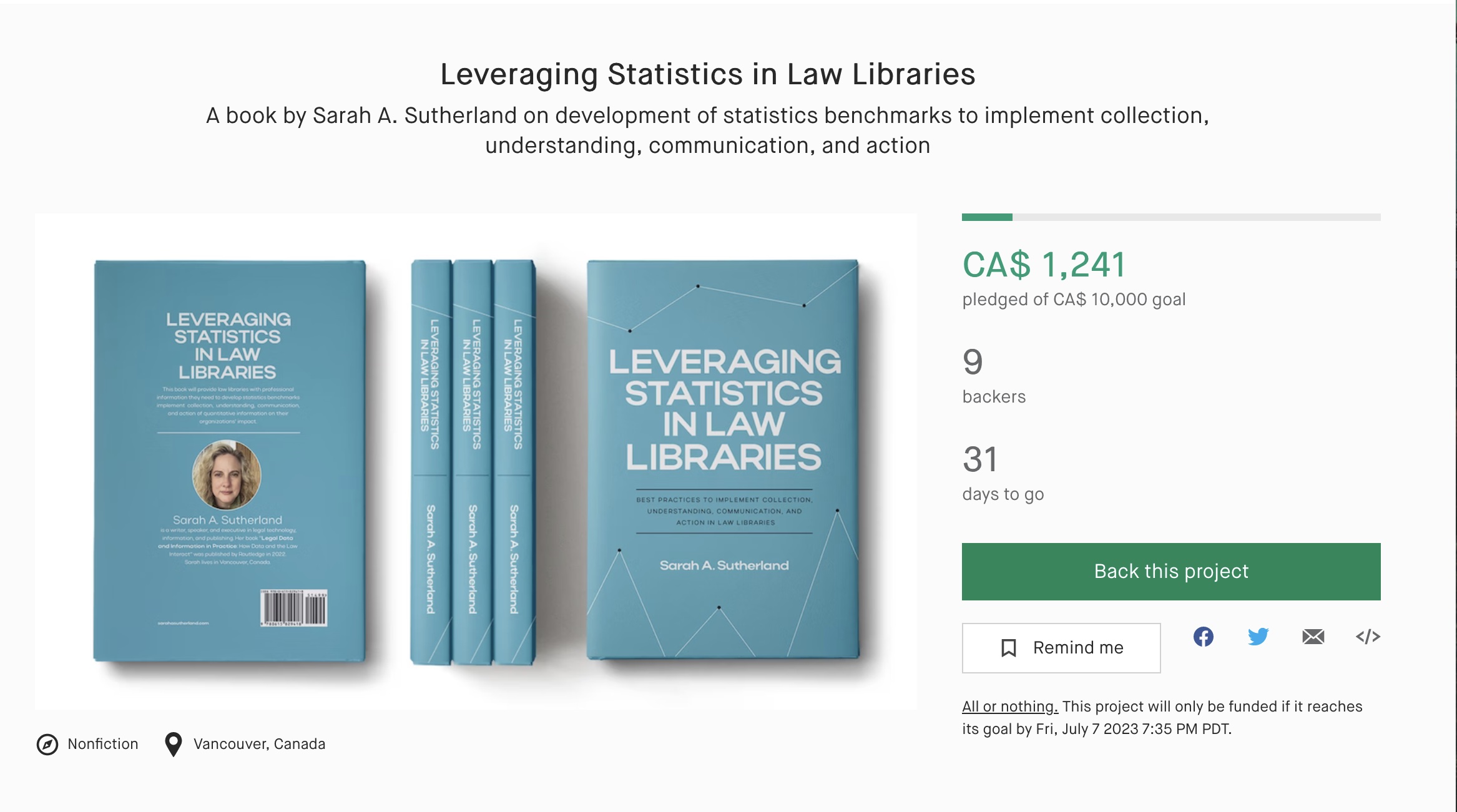
If you’d like to skip directly to the Kickstarter campaign, please click here.

I know that some people who would like to support my Kickstarter to fund the development of better tools for statistics in law libraries haven’t figured out how to handle the administration of a payment. If this is your situation, I’d like to let you know that payments are not charged until the project is fully funded when it concludes on July 7, 2023. So you can make a pledge now and figure the accounting out later. If it turns out to be a problem, you can also cancel your pledge anytime before the deadline (though of course I hope you won’t). There is more information about how pledges are handled on the Kickstarter backer FAQ page.

Running a Kickstarter campaign is a new way to fund the development of legal texts, and I know it can be inconvenient to figure out how to administer things like this, but it’s worth it! This model of developing legal materials will allow the community to help ensure that the tools we need are available. Libraries regularly purchase books before they are published, and this is just another way to handle that.

Here is some background on why I am doing this project on Slaw.ca. There is also more information about the project on the Kickstarter campaign page, and if you’re still not sure about it, please check back. I will be posting a table of contents in the coming days.

Moving the Field Forward: a Kickstarter to Support Law Libraries Statistics

If you’d like to skip directly to the Kickstarter campaign, please click here.

Libraries are increasingly required to use evidence in their management and reporting to ensure that the services they provide are appropriate and that they are communicating their impact to stakeholders. Library staff also need better insights into how resources are used and what stakeholders need to make decisions that reflect user needs. Better statistics have the potential to drive important improvements in how we manage law libraries, but it is hampered by the fact that much of the value libraries provide is not easily assessed. 

Traditionally, libraries monitor things like how many books circulate or how many people enter the physical space. As collections move online and the use of physical premises shifts, these don’t convey the value libraries actually provide anymore. I have done research which shows that improving the information used in the decisions lawyers advise on has significant value. There are also alternative ways to think about libraries’ contributions.

This is a perfect example of a topic that is poorly handled in the current publishing landscape: it has a small audience, is technically challenging, and is both too small to be suitable for a book topic and too large to be viable as an article. It is also not sufficiently valuable in any individual organization to be something that consultants would be likely to be hired to create, partly because having shared standards that are widely understood and used is more valuable than an individual institution creating something internal.

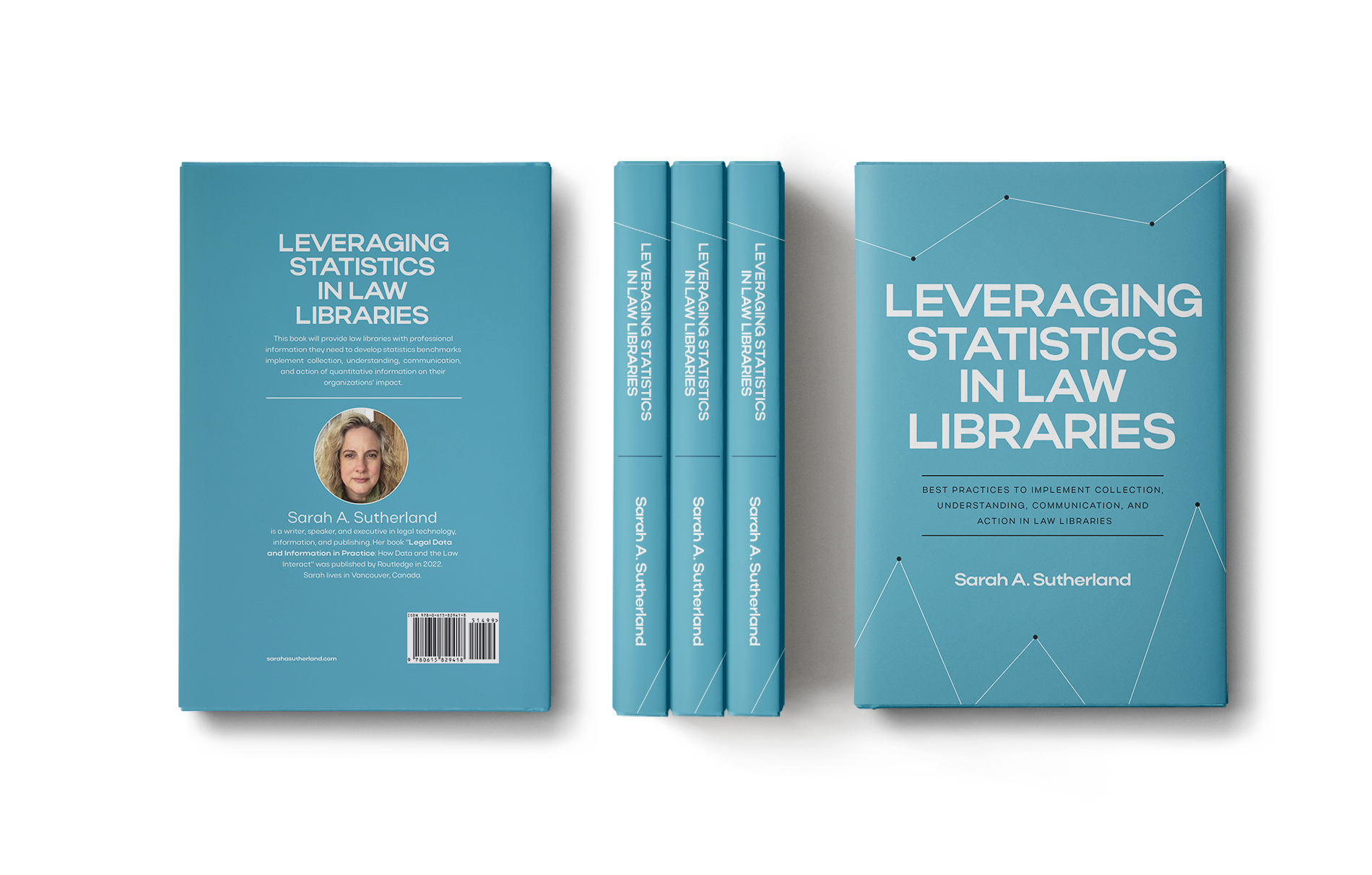
I am working to build a new way to fund resources like this. My first attempt is a Kickstarter campaign to facilitate the development of a book on statistics for law libraries. I will do primary research to develop industry standards and better understanding to help law library staff develop their management, practice, and reporting using quantitative methods.

In this project I propose to do research integrating a deep knowledge of data and its application in the management of information organizations, and a literature review, as well as a series of interviews with people working in law libraries around the world. This will be integrated into a book which will be made available in ebook and professionally produced print formats. 

My main goal is to develop systems for the particular needs that libraries have for their data. It will also include guidance on how to approach the questions of what to collect and how to interpret it based on organizational goals. Not every organization has the same priorities and data programs should reflect that.

I hope you will be willing to pitch in to help create this resource, or perhaps you will think of your own gap to fill.

This post was originally published on Notes Between Us.

Back to Top